
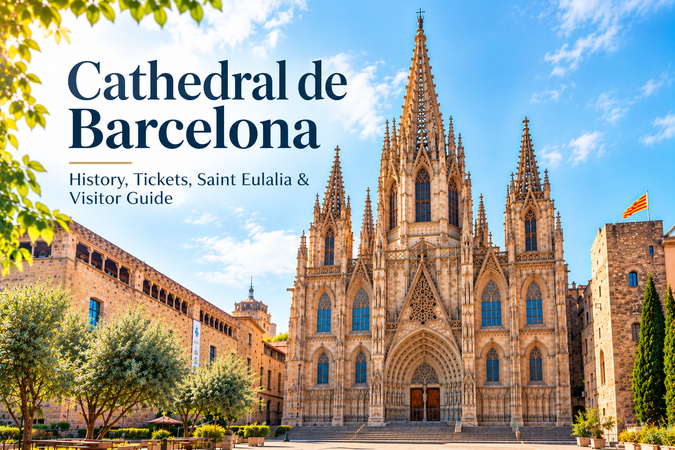
Barcelona is known for its beautiful architecture, famous landmarks, beaches and lively streets. But if you want to understand the city’s older history, one place you should not miss is Cathedral de Barcelona, located in the heart of the historic Gothic Quarter.
Officially called the Cathedral of the Holy Cross and Saint Eulalia, Barcelona Cathedral is one of the most important religious and historic buildings in the city. It is also commonly known as Catedral de Barcelona or La Seu.
The cathedral is famous for its Gothic architecture, centuries-old history, connection with Saint Eulalia, peaceful cloister, 13 white geese, historic choir and rooftop views over Barcelona.
A visit is not only about looking at the impressive façade from Pla de la Seu. With a Cathedral de Barcelona ticket, visitors can explore several historic spaces inside the complex, including the cathedral floor and cloister, rooftop, choir, Chapter Hall and other cultural areas.
In this guide, you will learn about the history of Cathedral de Barcelona, the story of Saint Eulalia, its architecture, what you can see inside, Cathedral de Barcelona ticket prices, visiting hours, activities, rooftop access and how to reach the cathedral.
What Is Cathedral de Barceloina?
Barcelona Cathedral is the historic cathedral of the Archdiocese of Barcelona. It stands in the Gothic Quarter (Barri Gòtic), one of the oldest and most atmospheric parts of the city.
The cathedral is dedicated to the Holy Cross and Saint Eulalia. Saint Eulalia is traditionally considered one of Barcelona’s patron saints, and her story is closely connected with the cathedral.
The building visitors see today is primarily Gothic, but the history of the site is much older.
According to the Cathedral’s historical records, Christian worship existed in Barcelona from the early centuries of Christianity. Earlier religious buildings stood on or near this site before the medieval Gothic cathedral was constructed.
This makes Barcelona Cathedral more than a medieval monument. It represents different periods of Barcelona’s religious, architectural and cultural history.
Cathedral de Barcelona History
The history of Barcelona Cathedral goes back more than a thousand years.
An early Christian basilica existed in Barcelona by the 4th century. Over time, the religious complex developed and changed as the city grew.
A Romanesque cathedral was later constructed on the site and was consecrated in 1058.
Eventually, the Romanesque building was replaced by the much larger Gothic cathedral.
Construction of the present Gothic cathedral began in 1298. The project continued for generations, with different sections being built and completed over many years.
The cloister was completed in the 15th century, while other parts of the building continued to develop.
Because of this long construction history, Barcelona Cathedral contains architectural and artistic elements from different periods.
The façade that visitors see today also has a more recent history. Although the main Gothic structure is medieval, important parts of the façade and central tower were completed much later.
This combination of medieval construction and later additions is one of the interesting things about the cathedral.
When Was Cathedral de Barcelona Built?
The present Gothic Barcelona Cathedral began construction in 1298.
However, it would be incorrect to say that the cathedral itself is only around 700 years old. The site had earlier Christian and Romanesque religious buildings.
The Gothic construction took place over a long period, with different parts completed at different times.
This is why the history of Barcelona Cathedral is best understood as a continuous story rather than the construction of a single building at one moment.
The Story of Saint Eulalia
One of the most important stories connected with Barcelona Cathedral is the story of Saint Eulalia.
According to Christian tradition, Saint Eulalia was a young Christian girl from Barcelona who became a martyr during the period of Roman persecution.
The Cathedral’s tradition states that she was 13 years old when she suffered persecution because of her Christian faith.
Her story has remained an important part of Barcelona’s religious heritage.
Inside the cathedral, visitors can find the crypt of Saint Eulalia, which contains her richly decorated Gothic sarcophagus.
Her story is also connected with one of the cathedral’s most recognizable traditions: the 13 white geese kept in the cloister.
The number 13 is traditionally associated with the age of Saint Eulalia at the time of her martyrdom.
Cathedral de Barcelona Architecture
Barcelona Cathedral is an important example of Catalan Gothic architecture.
The Gothic style can be seen in its pointed arches, large stone pillars, chapels, vaulted spaces, sculptures and detailed decoration.
Inside, the cathedral feels spacious and impressive. The central nave is surrounded by side aisles and chapels, creating a large interior with many details to discover.
One of the best ways to appreciate the architecture is to slow down and look at the smaller details rather than only taking photographs of the main altar or façade.
The building also demonstrates how medieval churches were closely connected with the communities around them. Many chapels were associated with institutions, guilds or families.
What Can You See Inside Barcelona Cathedral?
A tourist visit to Barcelona Cathedral offers access to several historic areas.
The official Cathedral currently lists the following visitable spaces:
- The Cathedral floor and Gothic cloister
- The rooftop
- The historic choir and Golden Fleece choir stalls
- The Chapter Hall
- The Jewish-memory area
- The Chapel of the Holy Christ of Lepanto
Let’s look at some of the highlights.
1. Cathedral de Barcelona Cloister
The Gothic cloister is one of the most peaceful parts of the cathedral.
It was constructed mainly during the 14th and 15th centuries and contains four galleries with pointed Gothic arches.
Inside the cloister is a garden, a historic fountain and a pond where the cathedral’s famous 13 white geese live.
The cloister is also associated with the traditional “Ou com Balla,” or “Dancing Egg,” celebrated around Corpus Christi. During this tradition, an egg is made to appear to dance on the water of the fountain.
2. Cathedral de Barcelona Rooftop
The Cathedral de Barcelona rooftop is one of the most popular parts of the tourist visit.
Visitors can reach the roof using an elevator accessed through the Chapel of the Innocent Saints near the Sant Iu entrance.
From the rooftop, you can see parts of the cathedral’s bell towers, pinnacles and central tower. You can also enjoy panoramic views over Barcelona and the surrounding historic area.
For people interested in photography, this is a particularly attractive part of the visit.
3. Historic Choir
The cathedral’s choir is another important part of the building.
Construction of the choir began in 1390, and its choir stalls are considered significant examples of Catalan Gothic sculpture.
The choir also has connections with the Order of the Golden Fleece and Emperor Charles V’s gathering in Barcelona in 1519.
4. Chapter Hall
The historic Chapter Hall has been converted into a museum space.
Visitors can see important historical and artistic objects here, including an 11th-century baptismal font from the former Romanesque cathedral.
The room also contains significant artworks, including the famous Pietà by Bartolomé Bermejo.
5. Saint Eulalia’s Heritage
For visitors interested in the history behind the cathedral, the connection with Saint Eulalia is an important part of the experience.
Her traditional story, crypt and artistic representations inside the cathedral help explain why she remains such an important figure in Barcelona.
6. Jewish Memory in the Cathedral
Barcelona Cathedral also presents part of the city’s medieval history through its Jewish-memory area.
The Cathedral Archive preserves thousands of historical documents and manuscripts that help researchers understand different communities and aspects of life in medieval Barcelona.
Cathedral Tickets: Price and What Is Included
If you want to explore the interior and visit the tourist areas, you will need a Cathedral de Barcelona tourist ticket.
The current official individual ticket price is:
€16 per person
Discounted tickets are currently available at €14 for eligible students up to 25 years old, large families and single-parent families, with the required documentation.
People with a disability of 33% or more and ICOM members currently have free admission under the Cathedral’s conditions.
For groups, the current listed price is €8 per person.
Because ticket prices and visitor conditions can change, it is best to check the official Cathedral website before your visit.
What activities are included with a Barcelona Cathedral ticket?
A tourist visit is more than simply entering the main church.
Depending on the current access conditions, visitors can explore:
- The main Cathedral
- Gothic cloister
- Rooftop and terraces
- Historic choir
- Golden Fleece choir stalls
- Historic Chapter Hall
- Jewish-memory area
- Chapel of the Holy Christ of Lepanto
This makes the ticket particularly useful for visitors who want to understand the history and architecture of Barcelona Cathedral rather than only see it from outside.
Cathedral de Barcelona Opening Hours
The current tourist and cultural visiting hours listed by the official Cathedral are:
Weekdays:
9:30 AM – 6:30 PM
Last access: 5:45 PM
Saturdays and religious holiday eves:
9:30 AM – 5:15 PM
Last access: 4:30 PM
Sundays and religious holidays:
2:00 PM – 5:00 PM
Last access: 4:30 PM.
These are tourist visiting hours. Barcelona Cathedral is also an active place of worship, so religious services and special events can affect access.
Always check the official schedule before travelling.
Cathedral de Barcelona Activities and Events
Barcelona Cathedral is not only a tourist attraction. It continues to function as a religious and cultural institution.
Its official activities calendar includes Masses, religious celebrations, processions, concerts, exhibitions and other events.
Some activities take place at specific times or on special religious dates, so they should not be confused with the standard tourist visit.
The cathedral also organizes special cultural events. For example, the traditional Ou com Balla takes place in the cloister around the Corpus Christi celebrations.
If you are visiting Barcelona during a major festival or religious celebration, checking the Cathedral’s activities calendar can help you find something different from a normal sightseeing visit.
How to Reach Barcelona Cathedral
Barcelona Cathedral is located at:
Pla de la Seu, s/n, 08002 Barcelona, Spain.
It is in the centre of the Gothic Quarter, making it easy to combine with other historic attractions.
By Metro
Jaume I is one of the most convenient metro stations for reaching Barcelona Cathedral.
From the station, you can walk through the historic Gothic Quarter towards Pla de la Seu.
On Foot
If you are already visiting the Gothic Quarter, walking is one of the best ways to reach the cathedral.
You can combine your visit with places such as Plaça Sant Jaume, Carrer del Bisbe, the old Roman walls and other historic streets.
By Bus
Several Barcelona city bus routes operate around the Ciutat Vella area. Depending on your starting point, you can get off near the Gothic Quarter and continue walking.
Best Time to Visit Barcelona Cathedral
For a more relaxed experience, a weekday morning can be a good option.
If you are mainly interested in photography, consider visiting when there is enough daylight for the rooftop and surrounding streets.
Before visiting, check the official tourist schedule because religious celebrations can change access times.
If you want to explore the Cathedral properly, allow approximately one to one and a half hours.
You may want more time if you enjoy photography, architecture, art or historical details.
Barcelona Cathedral vs Sagrada Família
Visitors sometimes confuse Barcelona Cathedral with the Sagrada Família, but they are completely different buildings.
Barcelona Cathedral is the historic cathedral located in the Gothic Quarter and is strongly associated with medieval Barcelona.
The Sagrada Família is Antoni Gaudí’s famous basilica in the Eixample district.
If you have time, both are worth visiting because they show two very different sides of Barcelona’s architectural history.
Barcelona Cathedral helps you understand medieval Barcelona, while the Sagrada Família represents the city’s famous Modernisme tradition.
Is Cathedral de Barcelona Worth Visiting?
Yes, especially if you enjoy history, architecture, photography and Barcelona’s old city.
The exterior is impressive, but the interior experience makes the visit much more interesting.
You can walk through the Gothic cloister, see the 13 white geese, learn about Saint Eulalia, explore historic chapels and artworks, visit the choir and Chapter Hall, and go up to the rooftop for views of Barcelona.
The cathedral also gives visitors an opportunity to experience a quieter side of the Gothic Quarter.
Outside the cathedral, Barcelona can feel busy and energetic. Inside the cloister, the atmosphere can feel completely different.
That contrast is one of the reasons Barcelona Cathedral remains an important part of the city’s identity.
Frequently Asked Questions About Cathedral de Barcelona
1. How much is the Barcelona Cathedral ticket?
The current individual tourist ticket is €16 per person. Discounted admission of €14 is available for eligible students up to 25, large families and single-parent families. Some eligible visitors, including people with a disability of 33% or more and ICOM members, can enter free. Group admission is currently €8 per person.
2. What is included in the Barcelona Cathedral ticket?
The tourist visit includes access to several visitable areas, including the Cathedral floor and cloister, rooftop, historic choir, Golden Fleece choir stalls, Chapter Hall, Jewish-memory area and Chapel of the Holy Christ of Lepanto, subject to current visitor conditions.
3. Can I visit the Barcelona Cathedral rooftop?
Yes. The rooftop is one of the highlights of the tourist visit. Visitors can reach it by elevator through the Chapel of the Innocent Saints near the Sant Iu entrance.
4. How long does a Barcelona Cathedral visit take?
Around 1 to 1.5 hours is a good starting point for seeing the main areas. Visitors interested in photography, history and architecture may prefer to spend longer.
5. What are the Barcelona Cathedral opening hours?
The current tourist hours are 9:30 AM–6:30 PM on weekdays, 9:30 AM–5:15 PM on Saturdays and religious holiday eves, and 2:00 PM–5:00 PM on Sundays and religious holidays. Last entry is earlier than the closing time.
6. Where is Barcelona Cathedral?
Barcelona Cathedral is at Pla de la Seu, s/n, 08002 Barcelona, in the Gothic Quarter.
7. What metro station is closest to Barcelona Cathedral?
Jaume I is one of the most convenient metro stations. From there, the cathedral is a short walk through the Gothic Quarter.
8. Can I see the 13 white geese at Barcelona Cathedral?
Yes. The Gothic cloister has a pond where the Cathedral’s traditional 13 white geese are kept. The number is associated with the traditional story of Saint Eulalia.
9. Who was Saint Eulalia?
Saint Eulalia is traditionally regarded as one of Barcelona’s patron saints. According to the Cathedral’s tradition, she was a young Christian martyr whose story became closely connected with Barcelona and the cathedral.
10. What activities are available at Barcelona Cathedral?
Along with the regular tourist visit, Barcelona Cathedral hosts religious celebrations, Masses, processions, concerts, exhibitions and special cultural activities throughout the year. The official activities calendar is the best place to check events for specific dates.
11. Is Barcelona Cathedral free to enter?
Tourist admission has a fee, currently €16 for an individual visitor. However, certain eligible visitors can receive free admission. Religious worship and tourist visits are separate, and access can vary during services and special celebrations.
12. Is Barcelona Cathedral worth visiting?
Yes. It is especially worthwhile for people interested in Gothic architecture, Barcelona’s history, Saint Eulalia, photography and the Gothic Quarter. The cloister, rooftop, choir, historic artworks and other visitable spaces make it more than an exterior sightseeing stop.
Final Thoughts
Cathedral de Barcelona is one of the best places to discover the older side of Barcelona.
Its history connects early Christianity, the Romanesque period, medieval Catalan Gothic architecture and the modern city. Its connection with Saint Eulalia adds a personal story to the building, while the cloister, 13 white geese, historic choir and rooftop give visitors several different things to discover.
If you are visiting Barcelona for the first time, don’t stop at the façade.
Take time to explore the inside, walk through the Gothic cloister, learn about Saint Eulalia, look at the historic artwork and architecture, and, if included and accessible during your visit, go up to the rooftop.
For travellers interested in Barcelona Cathedral history, Barcelona Cathedral tickets, Barcelona Cathedral rooftop, Gothic Quarter Barcelona, Saint Eulalia Barcelona, Catedral de Barcelona and Barcelona architecture, this historic church offers a fascinating introduction to the city’s past.